Showing posts with label Historical Fiction. Show all posts

Monday, May 11, 2015

Literary Tourism - Wyoming

Whales are one of my favorite things, but romance novels aren't.

When I was in college, some of my neighbors wanted to shoot off fireworks.  They wanted to do it legally so they went to Wyoming and I went with them.  My experience in Wyoming was eating at a truck stop and covering my ears while fireworks exploded.

Longing for Home by Sarah M. Eden

Katie Macauley has traveled all the way to the Wyoming frontier to work as a housekeeper and earn return passage to Ireland where she has left a tortured past.  Her goal is to get out of Hope Springs as quickly as possible.  But Irish are not welcome in that town and her employment brings responsibilities she can't handle.  Her prickly presence and refusal to be bullied cause a rucous in the town and thwart her plans.  A love triangle ensues..

I debated long and hard whether or not to count this for Wyoming because I find that romances are often weak on historical facts.  But this author really put the time and energy into creating an authentic period despite the all too convenient town name.  The land is dry and barren.  Each villager had to struggle to build irrigation and plant crops in a difficult terrain.  Conflicts between the Irish immigrants and long-time citizens of the United States felt real and deep.  In a place with limited resources of course there would be tension.

I read this book for my church book group and was pleasantly surprised by how much I liked it.  I tend to avoid romance, but I thought this one carried more depth than others I have read. The book is 100% clean which I think makes it feel more appropriate to the period as well.  I'm even excited to read the sequel. 

Friday, August 8, 2014

Literary Tourism - Tennessee

I've never been to Tennessee, but I imagine that it is rather muggy with lush, green plumage and very interesting people.  Am I right?

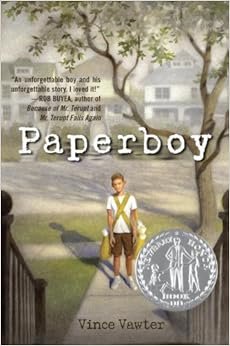
Paperboy - by Vince Vawter


A junior high age boy with a strong stutter takes on his friend's paper route for the month of July 1959.  Along the way his speech impediment and typical young adolescent behavior get him into some pretty big trouble.  He has the help of his African-American housekeeper, a friendly neighbor he meets delivering his papers and his father.


This book creates a great sense of place.  I planned to read this because it won a Newbery Honor this year and it just happened to work for this project as well.  I love when authors use specific street names.  He described the hot Memphis summer so well.  This perfectly matches what I wanted to see for my project.

Overall though, I did not love the book.  I've been debating on whether to give it two or three stars on Goodreads.  I think I have decided on three.  I liked how intelligent and challenging it was.  Some of the dialogue was pure gold.  But overall, I felt like the book was trying to cover too many issues.  The author was writing this largely as a memoir, but tried to include too many things in too short a story.  The book discusses racism, stuttering, deafness, homelessness, alcoholism, domestic violence, murder and mental illness all in less than 300 pages.

As a librarian, I always think about what child I would recommend this to, and I honestly can't think of anyone I would want to connect with this book.  This makes me sad.

This makes me happy.
 

Wednesday, July 2, 2014

Literary Tourism - Kansas

And back to the Midwest we go.  I used the website that I like to see what it offered for Kansas, but didn't get very far.  The Wizard of Oz takes place in more of a fantasy land than the state.  Then I remembered Sarah, Plain and Tall.  I was almost positive it took place in Kansas.  I reread it and discovered that it never actually mentions the state it takes place in.

I googled a few lists and found a bunch of rural horror novels which are seriously not my thing.  Then I found a list reminding me that, indeed, I had read a book set in Kansas.

Moon Over Manifest by Clare Vanderpool - Because I like historical fiction I enjoyed this book.  I don't think I would have liked it otherwise.  It tells the story of Abilene who is sent to Manifest, Kansas to live with her father's friends.  Flashbacks and a little mystery help intertwine Abilene's and her father's stories.  This is my review from Goodreads a couple years agao.

"This was a lovely historical fiction story of how a girl finds home and family. It expertly weaves the stories of father and daughter together. Abilene has a very strong voice and the flashbacks were well put together and emotional. While the outset of the story did not seem unique, many of the plot elements made this story unusual for children's literature. My one complaint is that it was very slow. It took me forever to read."

Honorable Mention 

Sarah, Plain and Tall by Patricia MacLachlin - While a number of websites list the setting of this book in Kansas, it is never explicitly stated in this book.  It may be revealed in the sequels, but I don't remember.  It deserves mention because I LOVE THIS BOOK.  I read it for the first time in third grade and the teacher who shared it with us brought it to life.  I think I felt connected to Sarah because she is originally from Maine.  It's a simple story about finding family and love.  An adult could easily read it in one sitting.  But it is packed full of emotion and meaning and strong characters.  I'm gushing I know, but seriously everyone should read this book.

"I just know that mommy's going to make me read this book."

Monday, June 9, 2014

Literary Tourism - Georgia and Alabama

Traveling to the South, I've picked two books similar in theme.  Both of these books deal with Asian families who have immigrated to the South.  It's a good setting because issues of race are so prevalent in southern culture.  The books  are distinctly different however because Japanese and Vietnamese culture are not one and the same, and the families portrayed in the stories are dealing with different challenges.

Georgia

Kira Kira by Cynthia Kadohata - Katie and her family are Japanese and move from a Japanese community to the deep south in Georgia.  Katie has a hard time getting used to all of the people staring at her and it is a difficult adjustment for them.  I read this book a few years ago so the details are a bit fuzzy, but the book did give a good sense of place.  I got annoyed at eh character Katie because she always said she was a bad girl, but she never did anything to prove it.

Alabama

"Don't take my word for it."*
 Inside Out and Back Again by Thanhha Lai - I'm a total sucker for a novel in verse so I loved this book, I actually reread this one so I could write a better review.  The book starts in Saigon just before it is taken over by North Vietnam communists.  Ha and her family escape to a boat are taken to Guam and are eventually sponsored by a family in Alabama.

Ha barely speaks English and encounters many new experiences - fried chicken, Christmas, and kids at school with many different skin tones.  She is bullied for her different looks and considered dumb because she hasn't mastered English grammar.

Lai writes based on her own personal experience as a refugee in Alabama which makes this book and her impressions even more authentic.  She is truly a poet and can give a great sense of place in just a few words.  If you like novels in verse I strongly recommend this book.   

*I was told my book reviews would be a lot more interesting with pictures of Joshua.

Friday, May 23, 2014

Literary Tourism - Utah

I have a little more time on my hands these days, so I've decided to return to my literary journey through the states.  I decided that the easiest way to find a book on Utah is to read one while I'm living here.

Because Utah is stereotypically Mormon, I actually refined my criteria for this project a little bit more.  I wanted a book that was nationally published.  (There are a lot of small publishers in Utah.)  I also didn't want a book about crossing the plains (strictly speaking not Utah) or polygamy (not an accurate representation of typical Utah life.)  It took some searching but I found one.

Missing in Action by Dean Hughes

During World War II, Jay's dad goes missing in the Pacific and his mom decides to move him from Salt Lake City to her hometown of Delta, Utah.  Delta is a small desert town - very typical of small Utah towns.  The community is mostly LDS, but Jay doesn't quite fit in.  His mom is not practicing and Jay is part Navajo.  A short distance away is a Japanese Interment Camp, and Jay gets to know Ken one of the prisoners who works for his grandfather.

Here we learn that Utah housed a lot of Japanese during the war -  a little known and rather embarrassing fact.  It also depicted the barren landscape and respectfully touched upon Mormon culture from the perspective of one who was not fully immersed in the religion.  So, the book did well for my purposes.

Missing in Action was missing action.  Honestly, I didn't finish the story.  Jay played baseball and talked to people and that's about it.      

Friday, August 16, 2013

Literary Tourism - Pennsylvania, Oklahoma, and Wisconsin

What do Wisconsin, Oklahoma, and Pennsylvania have in common?  Three Newbery Medal winners, of course!  Two of the following are absolutely two of my favorite children's books, and one has all the makings of a Newbery winner, but I thought it was just okay.

Pennsylvania


Dead End In Norvelt by Jack Gantos - This book wins the "tourism" prize for Pennsylvania because it opened my eyes to a part of America that I never knew existed.  Norvelt is a community that was created as a farming commune for underemployed coal minors in the 1930's.  It's name was derived from Eleanor Roosevelt even. 

While initially designed to be a sort of socialism, many of the residents eventually turned to capitolist traditions to make a living.  The book takes place in the 1960's, when the town is in decline.  Although not my favorite Newbery winner, it features a cast of quirky characters, like a boy with innummerable nose bleeds, crazy old people that seem to be dying every day, and a father busy digging up his wife's garden to build a bomb shelter.  It's worth a read if you like that kind of thing.

Oklahoma


Out of the Dust by Karen Hesse - I had a professor who called this book "The Grapes of Wrath light."  It's a dust bowl era novel in verse that will rip your heart our.  Billie Joe, her father, and her pregnant mother are trying to survive in Oklahoma during drought and depression.  Billia Joe's true love is playing the piano, but on accident she loses her mother and her baby brother.  Her hands are also scarred making it painful to play the piano.  Billie Joe and her father  must learn to depend on each other to survive.  Though the language is sparse the sensory details are incredible.  While reading, I felt grit in my teeth. 

I know that not everyone likes a book in poetry.  But if you are willing to try it, I highly recommend it.  While deeply sad, it does have a hopeful ending.

Wisconsin

The Westing Game by Ellen Raskin - I LOVE THIS BOOk.   I have probably read it 10 times.  Of all of the books, in this entry, the state it is set in is probably least important.  But some plot elements like a snowstorm and the building's overlook of Lake Michigan are important. 

A group of seemingly unrelated people all move into Sunset Towers, a new apartment building.  The new residents soon discover that they are connected to Sam Westing when he is murdered.  They are split into teams and charged with discovering the villian.  I love this book; I love the characters; I love everything about it.  Read it.  You'll discover why. 

Wednesday, August 14, 2013

Literary Tourism: Illinois, Michigan

For this journey we aren't going in any particular order.  Many of the books I've read recently seem to be centered in the midwest.  So, today I will cover two of those states.

Illinois


Hold Fast by Blue Balliett - Many of Balliett's mysteries are set in Chicago.  Her Chasing Vermeer series features a middle school at the University of Chicago.  Hold Fast is also a mystery, but deals with a different population in the city - the homeless.  Balliett writes beautiful mysteries that challenge readers to think abstractly.  This book impressed me so much because it was honest in discussing issues facing the homeless like substance abuse, being undervalues in society, and losing dignity and hope.  This book is also set in the main branch of the Chicago Public Library which I loved of course.

Michigan

Bud Not Buddy by Christopher Paul Curtis - I had no idea how important Flint was to Michigan until I found multiple references to it in literature.  After some research (read: a perusal of a Wikipedia article), I discovered that historically it was a center of industry.  This book is a historical novel of an orphan looking for his father and is very entertaining. 


Monday, October 1, 2012

Almost Accomplished

Within two weeks, I will have accomplished a New Year's resolution of sorts.  I will have completed 100 books this year.  I'm not sure whether to be proud or depressed about this accomplishment.  Seriously, who has that much time?  I've read some incredible books this year - some short, some long.  I've also read some duds, but that is to be expected.

Here are five of the books which I loved.  I loved more than five and if you want a complete list become my friend on Goodreads.

Ida B ... and Her Plans to Maximize Fun, Avoid Disaster, and Possibly Save the World, by Katherine Hannigan

Ida B. loves her life on the farm with her parents.  She is friends with the rocks and the trees and the mountains.  Her parents teach her school at home and that is how she likes it, but when her mom gets sick her whole life changes and she decides to have a hard heart.  If you like quirky characters and stories with a strong moral, this is the book for you.

How They Croaked: the Awful Ends of the Awfully Famous, by Georgia Bragg

Was this book gross?  Yes.  Was it awesome?  Yes.  This includes the fascinating and gory deaths of historic figures like Cleopatra and James A. Garfield.  It's factual, a little sarcastic, and a lot of fun.

Unbroken, by Laura Hillenbrand

This is probably one of the most talked about books in the past couple of years, and it deserves all the praise it receives.  It tells the story of an Olympian who survives a plane wreck and Japanese POW camps.  When he returns home he is able to put his life back together.  Every part of this lengthy book is exciting and inspiring.

Walk Two Moons, by Sharon Creek

 Because of my interest in children's literary history, I set a goal to read every Newbery Medal winning book.  I avoided this book because I didn't like the cover.  But seriously, the old cliche is true.  Read it.   It's wonderful.

 Wonder, by R.J Palacio

 This is another book worth the hype.  A kid with severe deformities decides to enter school starting the fifth grade.  Here he endures bullying, the challenges of finding friends, and other associated difficulties, but finds himself.  Okay, so I hate middle school angsty stories with classic bullies, but this one really was excellent.

And now for the books I don't recommend ...

Olive's Ocean, by Kevin Henkes

If you are actually reading my summaries, you will notice that I don't like  angsty, middle-school novels with bullies etc.  Yeah, this was one of those.

Fairies and the Quest for Neverland, by Gail Carson Levine

I love Gail Carson Levine, but I did not love this book.  I wish I had seen that Disney logo before wasting my time.

Small Persons with Wings, by Ellen Booraem

Maybe I should just avoid books involving fairies.  If you like fairies, you might enjoy this one.  

The Night Circus, by Ellen Morgenstern

In my opinion, this is the most overrated book of 2011.

Carry On, Mr. Bowditch, by Jean Lee Latham

Not all Newbery winners are winners.  This piece of historical fiction spent two much time explaining little bits of history and word origins and not enough time telling a story.     

Monday, February 25, 2008

Fever 1793, by Laurie Halse Anderson

Anderson, Laurie Halse. (2000). Fever 1793. New York: Simon & Schuster. 251 pages.

Summary and Evaluation:
Matilda is a fourteen year-old living in Philadelphia when a Yellow Fever epidemic ensues and her mother forces her to go to the country to escape the fever. Matilda and her grandfather never make it to the country, however, and Matilda herself must survive not only the disease but also the anarchy that ruled Philadelphia during the hot months of September and October. When she loses her grandfather, Matilda must learn how to care for herself and others as she overcomes the devastating effects of the fever.

Anderson presents a vivid description of a little known event in history. When I think of Philadelphia at that time, I conger up thoughts of Washington, Jefferson, and Adams debating and little about the everyday people that lived there. This presented a different picture of the city. I was especially shocked to discover how inhumane citizens treated their own family members. Whenever someone was thought to have contracted the fever, the other members of the household would force him or her to leave. Looters came to the city to find abandoned businesses. Matilda does find herself working with a friend and The Free African Society which was essentially the only group to help the sick and impoverished during this time. Anderson includes an appendix of historical notes so that the reader can separate the truth from the fiction.

Everyone around Matilda seems to lose their entire family and livelihood. Comparatively, Matilda loses little. Intruders break in to her family's coffee shop more than once, but never find her family's savings. Matilda manages to recover in almost record time. I was certainly glad to see that she did not lose everything, but it seems a little unrealistic for one person to have so much luck.

Booktalk Hook: I would most likely present this book to a group of middle school students because Matilda's age and the way the subject matter is handled seem most appropriate for that group. At the beginning of each chapter, Anderson uses an original quote to introduce the content. Some of them can be rather gruesome in their descriptions of the pestilence. I would begin with the quote by Dr. Benjamin Roth that says, "Shafts of death fly closer and closer to us everyday" (p. 138). Then I would describe Roth's old-fashioned bleeding treatments for the fever before I introduce the fictional character Matilda.